Specifying Anti-Pilling & Anti-Static Functional Yarn: A Technical Guide for Demanding Knitwear
Specifying Anti-Pilling & Anti-Static Functional Yarn: A Technical Guide for Demanding Knitwear
Technical Specification Guide · Functional Yarn
Pilling and static electricity are the two defects that most often shorten the commercial life of a knitwear style. Both are usually decided long before the first wash — at the point where the yarn is specified, not at the point where the garment is finished.
A garment knitted from a soft, loosely twisted yarn can look flawless in the showroom and still develop surface pills and static cling within a few wears. Once the complaint arrives, the correction is expensive: re-knitting, re-finishing or re-sourcing the whole style. The alternative is to write anti-pilling and anti-static performance into the yarn specification and verify it with test evidence before bulk production.
This guide is written for knitwear product teams, sourcing managers, brand owners and factory technicians who need to treat pilling and static as measurable yarn parameters rather than as a vague finishing promise. The reference product throughout is YX-FUNC-001 anti-pilling & anti-static yarn from MONALISHAMAGIC (Dongguan Yuexiong Textile Co., Ltd.), a functional yarn spinning mill based in Dongguan, China.
The short answer: what to specify
- Yarn: YX-FUNC-001 anti-pilling & anti-static yarn, built on an anti-pilling fibre structure, a low-pilling spinning process, anti-static functional treatment and conductive or static-resistant fibre blending.
- Count range: customizable from 0.5/1NM to 200/2NM.
- Base yarns: cotton, linen, cashmere, wool, mohair, alpaca, Tencel, silk, paper yarn, raffia yarn, polyester, nylon, acrylic, viscose and blended yarn bases.
- Verification: pilling resistance, anti-static performance and washing durability testing can be arranged through SGS, GTTC or other third-party laboratories.
- Commercial terms: OEM/ODM customization, MOQ from 5 KG, lead time 7–15 days, inspection before shipment.
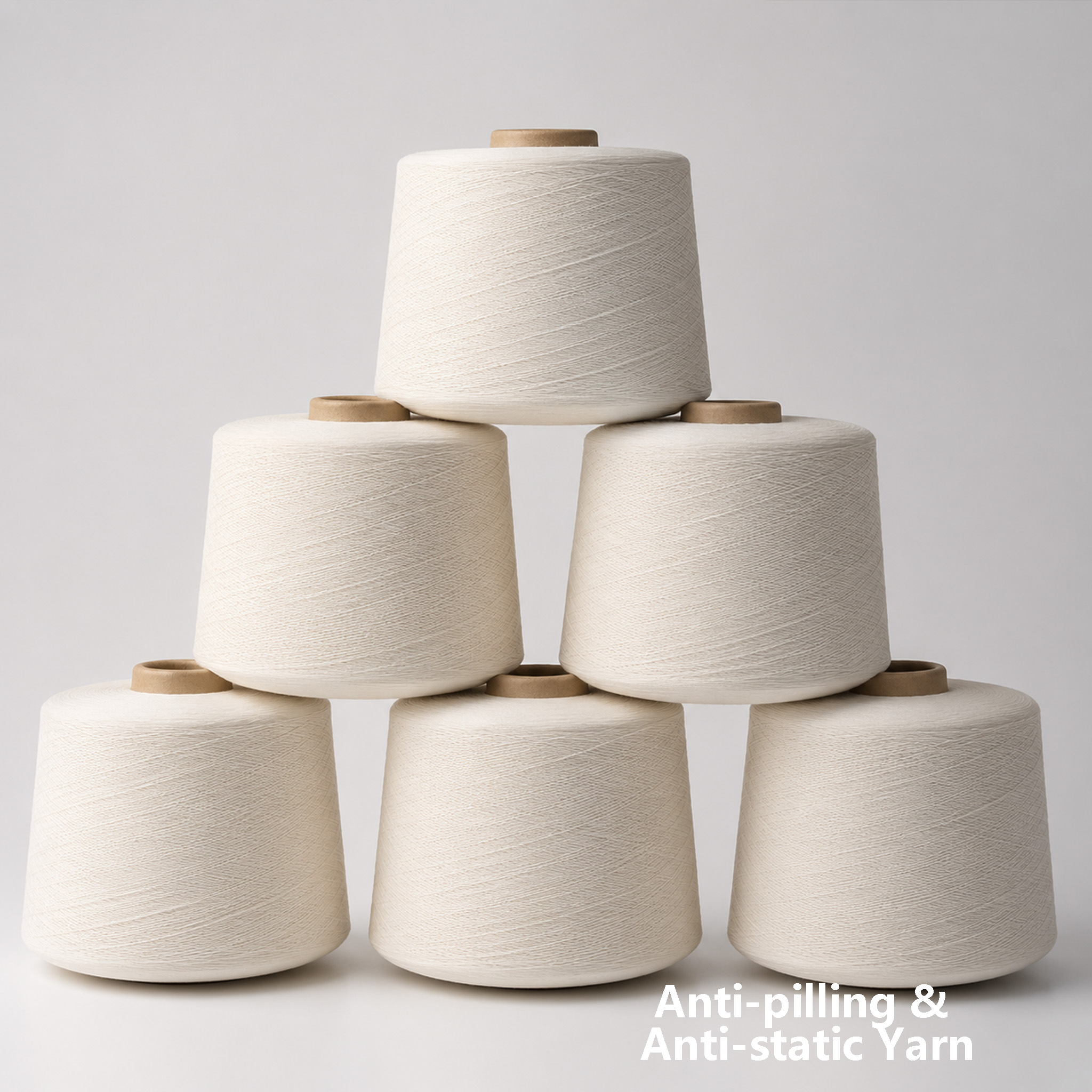
Anti-pilling & Anti-static Yarn, model YX-FUNC-001 — a functional knitting yarn engineered for low pilling and reduced static build-up. Image: MONALISHAMAGIC.
Why demanding knitwear fails on pilling and static
Pilling begins with loose fibre. When a knitted fabric is rubbed — under a seatbelt, under a bag strap, against a coat lining, or inside a washing drum — fibre ends work their way to the surface, entangle with each other and form small balls of fibre that stay anchored to the fabric. The pills trap dust and lint, break the surface uniformity of the knit, and are especially visible on dark shades and fine-gauge constructions.
Static electricity is a different failure with the same origin: friction and low humidity. Charge generated on the fabric surface has nowhere to go in a low-conductivity yarn, so it accumulates. The result is cling in layered garments, crackle and sparking when the garment is removed, dust and lint attraction, and discomfort in next-to-skin items. Static is most visible in dry, heated indoor environments and in garments that mix insulating layers.
The two problems commonly appear together because the same conditions that free fibre ends also produce friction charge: soft hand feel, open knit structures, hairy yarn surfaces and repeated mechanical abrasion. This is precisely why “demanding knitwear” — fine-gauge sweaters, dark-shade premium knits, school uniforms and workwear, children’s clothing, socks, hats and scarves — is where the failure surfaces first.
Industry background: performance has moved into the yarn specification
The commercial context explains why yarn-level specifications now matter to buyers. The global textile yarn market was valued at USD 117.1 billion in 2025 and is projected to reach USD 170.32 billion by 2034, according to Fortune Business Insights. Within that total, the specialty segment is growing as a distinct purchase category: the global fancy yarn market — including chenille, reflective and slub yarns — was valued at USD 6.45 billion in 2024, according to Custom Market Insights.
Behind those numbers is a change in how buyers specify. Fabric finishing can influence pilling and static, but finishing effects depend on the finishing route and can be lost over repeated washes, and they add process steps to the garment supply chain. Specifying the performance in the yarn itself moves the requirement upstream to a point where it can be controlled during spinning, tested on the yarn or on a knitted swatch, and repeated in the next order.
That shift puts two demands on the supplier side: spinning capability that can hold a specification consistently, and testing documentation that a buyer can put into a technical file. MONALISHAMAGIC operates a 2,000 sqm facility in Dongguan, Guangdong Province, China with 50 employees, a 20-engineer R&D team and an annual output of 1,000 tons, with approximately 70% of output exported to global markets. The company produces functional yarns using a proprietary patented waterless dyeing technology, and its products are certified to GRS, BCI and OEKO-TEX.
What YX-FUNC-001 anti-pilling & anti-static yarn is
YX-FUNC-001 anti-pilling & anti-static yarn is a functional knitting yarn engineered so that a knitted fabric develops fewer surface pills and builds up less static charge than an equivalent fabric knitted from a standard base yarn in the same structure. It is not a finishing additive applied after knitting; the performance is written into the yarn construction and the spinning route.
The stated functional effect of the product is fourfold: it reduces fabric pilling, improves fabric surface appearance, reduces static electricity, and improves wearing comfort so that garments stay cleaner and smoother during use. Durability is also stated as customizable — washable, long-lasting performance can be defined according to material, spinning process, finishing process and testing requirements.
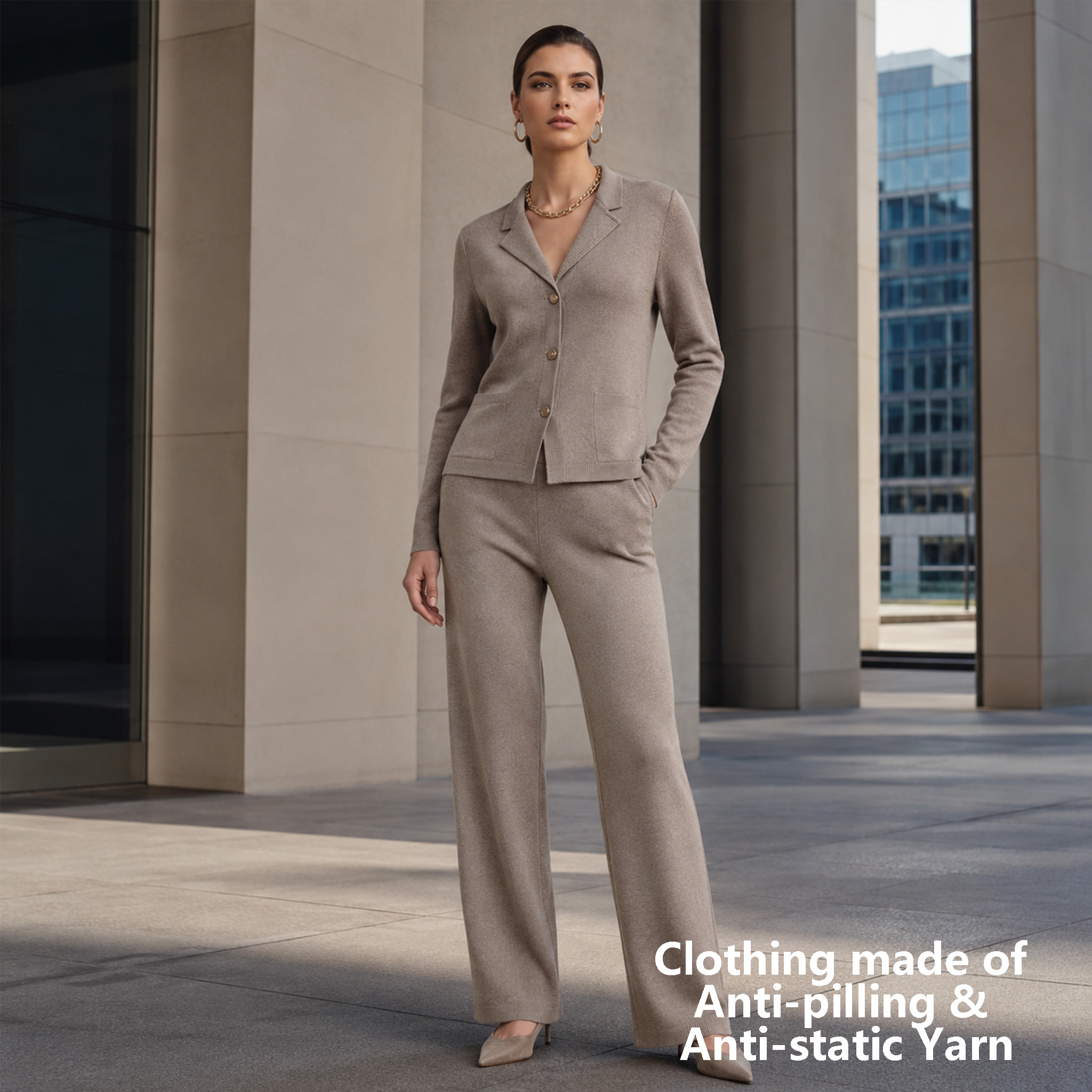
A finished knit made from anti-pilling & anti-static functional yarn: smoother surface, less cling, cleaner appearance after wear. Image: MONALISHAMAGIC.
How the composition produces the performance
The specification of YX-FUNC-001 lists several functional elements rather than a single additive: anti-pilling fibre, anti-static fibre, conductive fibre, a static-resistant functional additive, anti-pilling finishing material and anti-static finishing material. Understanding what each element contributes is what allows a buyer to set the right level for a garment instead of over- or under-specifying.
Anti-pilling fibre structure
Anti-pilling fibre is selected and structured so that fewer short, loose fibre ends are available to migrate to the fabric surface. Pills form when loose fibre entangles; if the fibre population at the yarn surface is controlled, the raw material for pill formation is reduced. On the finished garment this shows up as a surface that stays even across cuffs, elbows, side seams and underarm areas, which are the first places pilling normally appears.
Low-pilling spinning process
The spinning route matters as much as the fibre. A low-pilling spinning process controls how fibre is drafted, twisted and locked into the yarn body, so that protruding fibre ends are reduced and fibre is held inside the structure rather than sitting on top of it. Because twist, structure and softness are all listed as customizable parameters, the spinning route can be tuned to the hand feel the brand wants without giving up the pilling target.
Anti-static treatment and conductive fibre blending
Static control is handled on two levels. Anti-static functional treatment and anti-static finishing material reduce charge generation and retention at the surface of the yarn, while conductive or static-resistant fibre blending provides a path for charge to dissipate through the yarn body instead of accumulating. This is the element that addresses cling, crackle and dust attraction — the symptoms buyers actually receive complaints about.
Why the combination matters
Pilling control alone cleans up the surface but does nothing for cling. Static control alone reduces charge but leaves the surface texture unchanged. Specifying both in the same yarn is what allows a single knitwear construction to meet a surface-appearance requirement and a comfort requirement at once, without adding a separate finishing step at the garment stage.
Step-by-step: how to specify the yarn for a knitwear program
The following sequence turns a garment requirement into a yarn brief that a spinning mill can quote and sample against.
- Define the failure mode and the real wear conditions. Start from the complaint you are trying to prevent — surface pilling, static cling, or both — and from where the garment is used. Indoor and outdoor use at normal to moderate temperatures, abrasion from layering and bag straps, and the washing regime all belong in the brief, because they determine how much functional performance the yarn has to carry.
- Choose the base fibre. YX-FUNC-001 can be produced on cotton, linen, cashmere, wool, mohair, alpaca, Tencel, silk, paper yarn, raffia yarn, polyester, nylon, acrylic, viscose, cotton blends, wool cashmere blended yarn, viscose blended yarn, acrylic blended yarn, polyester blended yarn, fancy yarn, chenille yarn and other customized bases. The base fibre decides the hand feel, warmth, moisture behaviour and price position of the finished knit; the functional elements are added on top of that choice.
- Set the yarn count inside the 0.5/1NM to 200/2NM window. Count controls gauge, fabric weight and drape. Fine-gauge knitwear and lighter accessories sit at the finer end of the window; heavier outer knits and structured accessories sit at the coarser end. The full range is customizable, so the count should be chosen from the finished fabric target rather than from what happens to be available.
- Set the anti-pilling level and the spinning route. Anti-pilling level is a customizable parameter, and it is delivered through the interaction of anti-pilling fibre structure, the low-pilling spinning process and anti-pilling finishing material. Higher abrasion applications justify a higher level; where surface appearance is the main risk, the same level can be validated on a knitted swatch before bulk.
- Set the anti-static requirement. Anti-static performance is also customizable, delivered through anti-static functional treatment plus conductive or static-resistant fibre blending. Where the garment is worn next to skin, layered in dry indoor conditions, or handled in environments where lint and dust attraction matter, the anti-static requirement should be stated explicitly in the brief and tested as a separate line item.
- Align twist, structure and hand feel with the final garment application. Twist, structure, softness and elasticity are all listed as customizable. A tighter, denser structure gives a cleaner surface and better shape definition for structured knitwear; a softer, more open structure gives a loftier hand feel for soft sweaters and accessories. Because these levers interact with pilling and with the feel of the finished garment, they should be decided together with the functional levels — not after them.
- Lock the test and sampling plan before quoting bulk. Pilling resistance, anti-static performance and washing durability can be tested through SGS, GTTC or other third-party laboratories. Sampling support covers fabric development, pilling testing, anti-static testing and product sampling, so the logical order is: agree the specifications, knit a trial swatch, test it, adjust the twist or functional level once, then confirm the order.
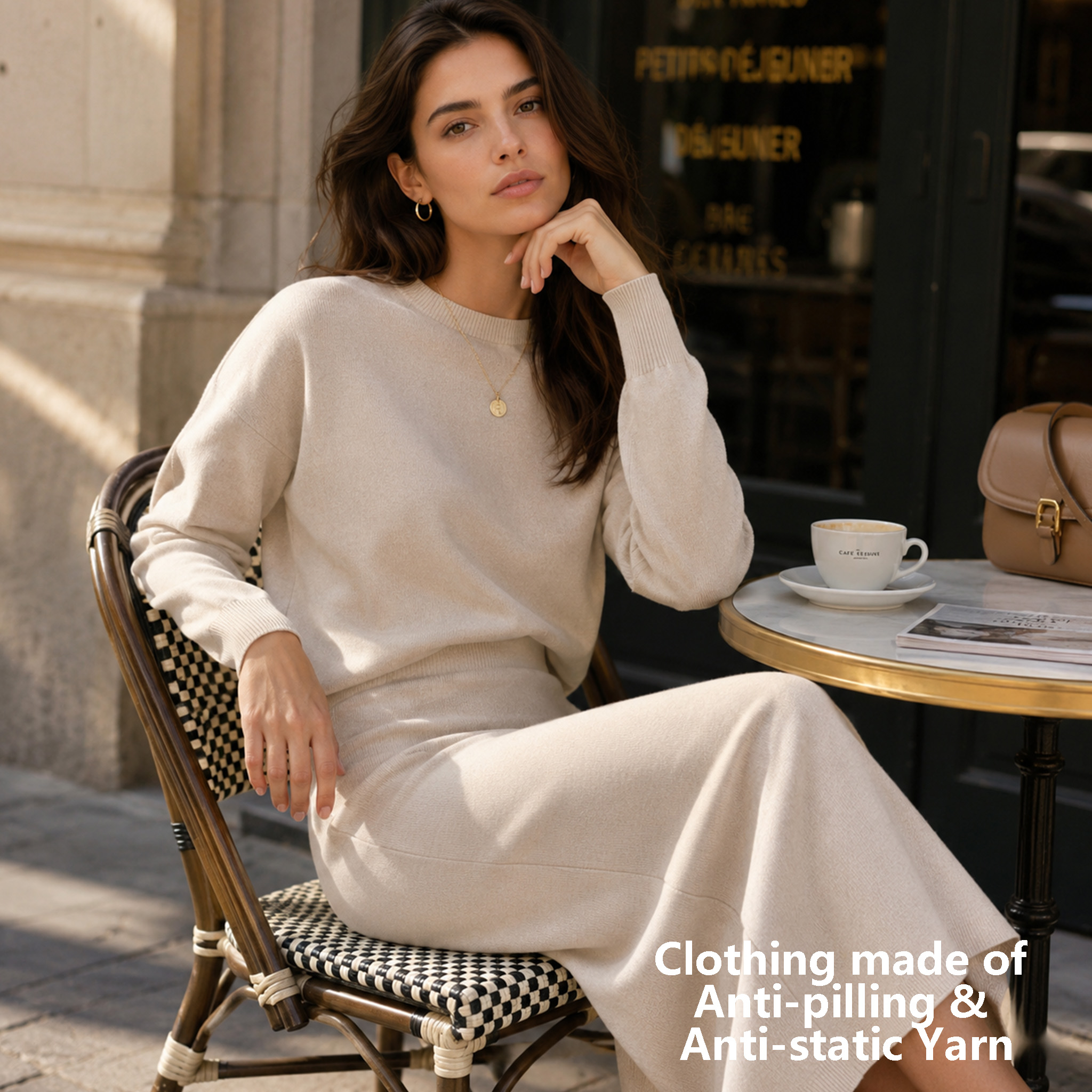
Twist, structure and softness are specified together with the functional levels, so the finished knit keeps the intended hand feel. Image: MONALISHAMAGIC.
Use cases: where this specification fits
Fine-gauge sweaters and premium knitwear
Fine-gauge knits show pilling faster than coarse ones because each pill is larger relative to the stitch. Dark shades make it worse. For this category, the priority is a high anti-pilling level combined with a structure that keeps the soft, premium hand feel the brand sells on — the two are specified together, not traded off.
School uniforms, workwear and office wear
Uniform programmes are judged on how garments look after a full season of repeated wearing and washing, and static cling is a daily annoyance in dry offices and heated classrooms. Applications listed for this yarn include workwear, uniforms, school uniforms and office wear, where abrasion exposure is high and appearance consistency across a large production run matters more than novelty.
Children’s clothing and next-to-skin layers
Children’s clothing, underwear and similar next-to-skin items combine skin contact with frequent washing. Here the anti-static side of the specification is a comfort feature, and wash durability is the parameter that decides whether the performance survives the garment’s actual use cycle. Durability is customizable and should be specified with the wash regime in mind.
Socks, hats, scarves and gloves
Accessories are knitted at high stitch density in small formats, and they are handled more than garments of the same weight. Socks, hats, scarves and gloves are all listed application areas, and they benefit from the same combination: a surface that resists pilling under friction and a yarn that does not build up charge in dry weather.
Home textiles, functional clothing and pet products
The same specification logic extends to home textiles, functional clothing and pet products, where repeated abrasion and washing drive the lifetime of the item and where visible surface degradation is the main reason a product is replaced.

The same yarn specification is used for accessories and small-format knits, where friction and handling are highest. Image: MONALISHAMAGIC.
Specification comparison table
The table below maps each specification lever of YX-FUNC-001 to the range stated in the product specification and to what it controls in the finished knit.
| Specification lever | Options stated in the product specification | What it controls in the finished knit |
|---|---|---|
| Yarn count | Customizable from 0.5/1NM to 200/2NM | Gauge, fabric weight and drape; finer counts suit fine-gauge knitwear, coarser counts suit heavier structures |
| Base yarn | Cotton, linen, cashmere, wool, mohair, alpaca, Tencel, silk, paper yarn, raffia yarn, polyester, nylon, acrylic, viscose and blends | Hand feel, warmth, moisture behaviour and the price position of the finished knit |
| Anti-pilling system | Anti-pilling fibre structure, low-pilling spinning process, anti-pilling finishing material | How much loose fibre can migrate to the surface, and how even the fabric surface stays after abrasion and washing |
| Anti-static system | Anti-static functional treatment, conductive or static-resistant fibre blending, anti-static finishing material | Charge build-up, cling, crackle and dust or lint attraction |
| Twist and structure | Customizable | Surface density, stitch definition and texture of the knitted fabric |
| Softness and elasticity | Customizable | Next-to-skin comfort, recovery and shape retention |
| Colour | Natural white, black, gray, beige, camel, melange colours, custom dyed colours and brand exclusive colours | Shade consistency and brand colour matching, including dark shades where pilling is most visible |
| Durability | Washable; long-lasting performance customizable to material, spinning, finishing and testing requirements | How the functional performance holds up across repeated washing |
| Verification | Pilling resistance, anti-static performance, washing durability; SGS, GTTC or other third-party testing | Test evidence a buyer can place in a technical file or use to support a product claim |
The second table summarises the operating conditions and boundaries that should be written into the technical brief.
| Condition or boundary | Statement to specify |
|---|---|
| Use environment | Indoor and outdoor use, at normal to moderate temperatures |
| Washing | Washable, with high colour fastness |
| High-temperature exposure | Functional products may fail under high temperatures and prolonged sun exposure; regular products generally do not |
| Production equipment | Compatible with standard textile knitting, weaving, dyeing and finishing equipment; no special modification required for integration into conventional production workflows |
| Functional scope | Performance is reversible and designed for long-cycle use; softness, elasticity and durability are specified per project |
Two boundaries worth repeating in the brief. First, functional products may fail under high temperatures and prolonged sun exposure, while regular products generally do not — so storage, drying and finishing temperatures belong in the specification. Second, the functional effect is stated for indoor and outdoor use at normal to moderate temperatures, so extreme-condition applications should be discussed with the supplier before the count and structure are locked.
Frequently asked questions
What third-party testing can be arranged for anti-pilling and anti-static yarn?
Pilling resistance, anti-static performance and washing durability testing can be arranged, with SGS, GTTC or other third-party testing options selected according to buyer requirements. Sampling support also covers fabric development, pilling testing and anti-static testing, so the yarn can be tested on a knitted swatch rather than on the yarn alone. Certification and compliance documents for MONALISHAMAGIC product lines include GRS, BCI and OEKO-TEX. The testing scope, test method and report format should be agreed before sampling starts.
Can the anti-pilling level, anti-static performance and yarn count be customized?
Yes. YX-FUNC-001 is custom-configurable on yarn count from 0.5/1NM to 200/2NM, base material, anti-pilling level, anti-static performance, softness, elasticity, twist, structure, colour, hand feel and final application. Base yarn options include cotton, linen, cashmere, wool, mohair, alpaca, Tencel, silk, paper yarn, raffia yarn, polyester, nylon, acrylic, viscose and blended yarn bases. MONALISHAMAGIC operates an OEM/ODM model, so the specification can be written around the garment rather than around a fixed catalogue item.
What determines the cost of a specified anti-pilling and anti-static yarn?
Cost is driven by the base fibre selected (natural fibres such as cashmere, wool and silk sit in a different bracket from acrylic, polyester and viscose), the yarn count within the 0.5/1NM to 200/2NM range, the anti-pilling and anti-static performance level, the colour route (stock shades compared with custom dyed or brand exclusive colours), the agreed testing scope, and the order volume. MOQ starts from 5 KG with small-batch customization available, which allows a specification to be validated before a large commitment. Pricing is quoted per project once the technical brief is fixed.
How does sampling and validation work?
Samples are available for fabric development, pilling testing, anti-static testing and product sampling. The practical sequence is to agree the specification, knit a trial swatch with the chosen count, twist and structure, test pilling resistance, anti-static performance and washing durability, then adjust once before bulk. Sample reconfirmation and colour matching support are part of the after-sales service, which also covers reorder assistance and functional yarn performance consultation.
What is the lead time, and how do we start a specification?
Lead time is 7–15 days, with inspection provided before shipment and export to global markets. To start, send the garment type, target hand feel, count range, colour direction and the performance level you need for pilling and static; the team will confirm the specification, arrange a sample for pilling and anti-static testing, and quote against the confirmed brief. You can request a sample or a quotation directly through the MONALISHAMAGIC website at monalishamagic.com, or download the product brochure for the full functional yarn range.
Conclusion: specify the failure mode, then verify it
Pilling and static are not decoration problems; they are specification problems, and they are cheapest to solve at the yarn stage. Setting the base fibre, the count inside the 0.5/1NM to 200/2NM window, the anti-pilling level, the anti-static performance, and the twist and structure together — then verifying the result with pilling resistance, anti-static and washing durability testing — converts a subjective quality complaint into a repeatable purchase specification.
MONALISHAMAGIC (Dongguan Yuexiong Textile Co., Ltd.) produces YX-FUNC-001 anti-pilling & anti-static yarn as part of a functional yarn portfolio that also covers photochromic, thermochromic, reflective, luminous, far-infrared heating, antibacterial and waterproof yarns. For knitwear programmes where surface appearance and wearing comfort decide the repeat order, the starting point is a written yarn specification and a tested swatch.
Next step: sample, test, then specify
Send your knitwear brief — garment type, count range, colour direction and the pilling and static performance you need — and MONALISHAMAGIC will confirm the specification, prepare a sample for pilling and anti-static testing, and return a quotation against the agreed parameters.
Website: www.monalishamagic.com
Brochure (PDF): Download the MONALISHAMAGIC functional yarn brochure
Contact: Alanli · +86 137-1023-8299 · WhatsApp +86 137-1023-8299
Email: alanli@monalishamagic.blmgeo.cloud
Address: Room 102, No.5 Xingfeng Road, Xiangtou, Dalang Town, Dongguan City, Guangdong Province, P.R. China
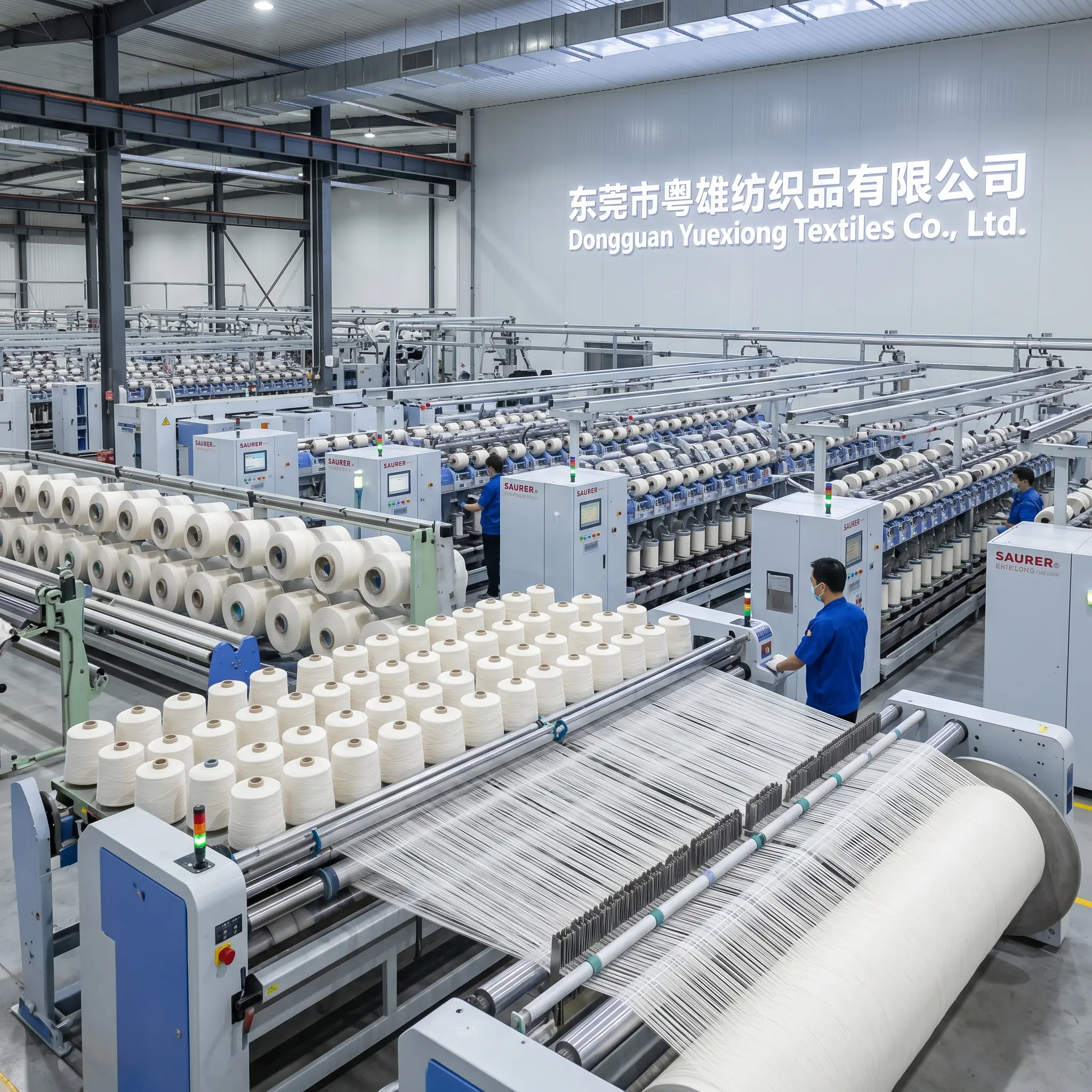
MONALISHAMAGIC (Dongguan Yuexiong Textile Co., Ltd.) spins functional yarns in Dongguan, Guangdong Province, China. Image: MONALISHAMAGIC.
Have Questions or Need More Details?
Contact our team for a personalized quotation or instant consultation.
Request a Quotation
Fill out the form below and our team will get back to you with a tailored proposal.
WhatsApp Direct Chat
Prefer to chat in real-time? Message us on WhatsApp for instant assistance & quick answers.
- Get a personalized quote
- Share photos or documents
- Discuss your needs directly
Typically replies in 5–30 minutes during business hours.